
Cataract surgery has evolved significantly with advancements in ophthalmic technology, giving surgeons and patients access to a wider range of intraocular lens (IOL) options. While conventional monofocal IOLs remain an important choice for cataract treatment, premium IOLs are designed to address broader visual requirements and may help reduce dependence on spectacles for selected patients.
At Devine Meditech, the focus is on developing and supplying advanced ophthalmic solutions designed around different surgical requirements and patient visual needs. The company's IOL portfolio includes hydrophobic and hydrophilic lenses, aspheric IOLs, toric IOLs, multifocal IOLs, EDOF lenses and phakic IOLs.
Premium intraocular lenses are advanced lens options used during cataract surgery to provide vision correction beyond the basic correction offered by a conventional monofocal lens. Depending on the lens design, premium IOLs can support vision at different distances or address specific refractive conditions such as astigmatism. The selection of an IOL should always be based on an individual patient's eye health, lifestyle, visual expectations, measurements and the ophthalmologist's clinical assessment.
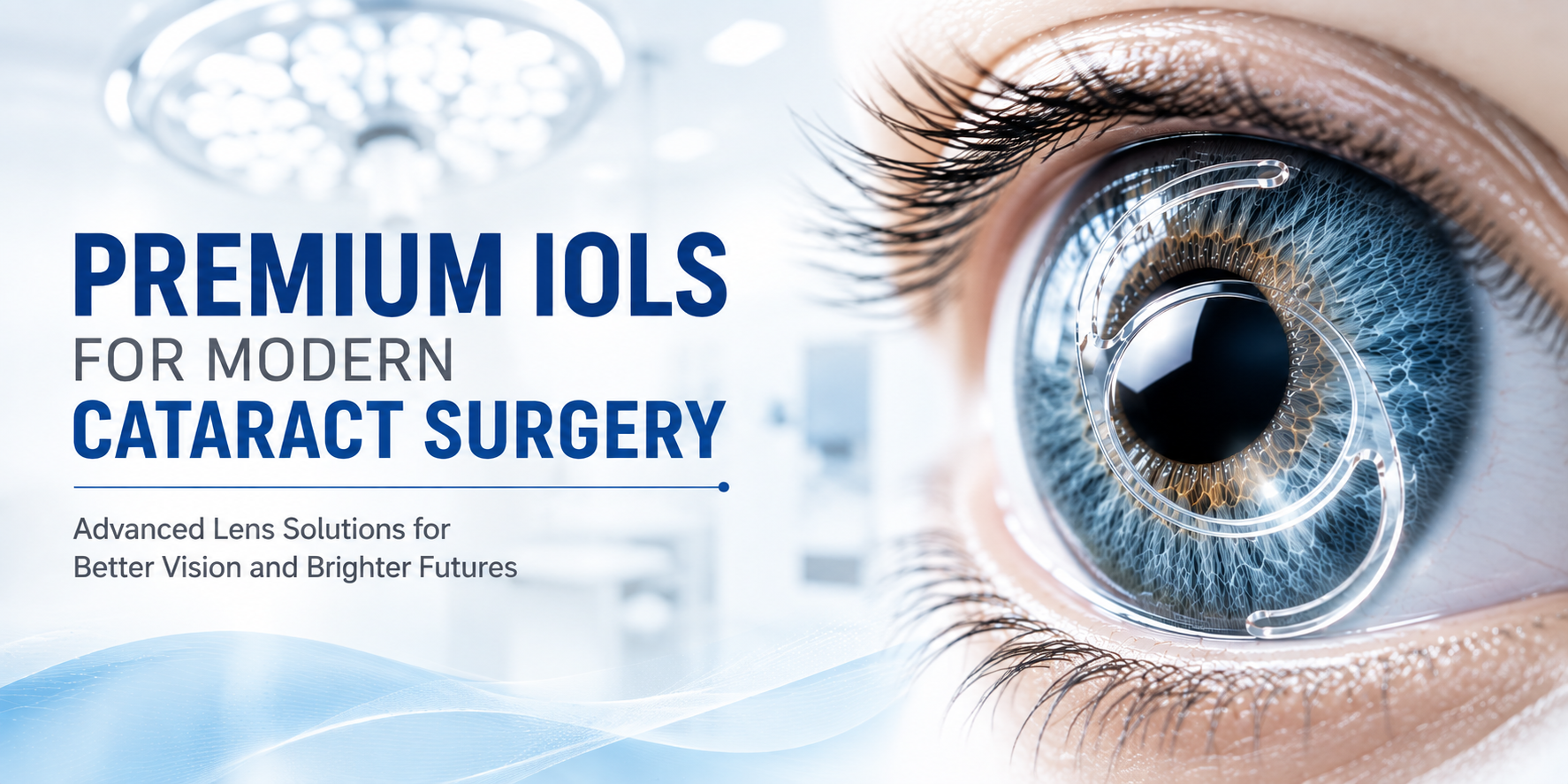
1. Multifocal IOLs
Multifocal IOLs are designed to provide vision at multiple distances and can help suitable patients reduce their dependence on spectacles for activities such as reading, using digital devices and distance viewing.
2. Trifocal IOLs
Trifocal IOLs are an advanced type of multifocal lens designed to provide functional vision at distance, intermediate and near ranges. They can be particularly beneficial for patients who want greater spectacle independence for activities such as driving, working on computers, using smartphones and reading. Trifocal IOL selection should be based on detailed pre-operative evaluation, ocular health and the patient's visual expectations.
3. EDOF IOLs
Extended Depth of Focus (EDOF) IOLs are designed to extend the range of functional vision, particularly supporting distance and intermediate vision. They may be considered for patients seeking reduced spectacle dependence while maintaining a specific visual profile.
4. Toric IOLs
Toric IOLs are designed to correct corneal astigmatism during cataract surgery. They can provide a more comprehensive refractive solution for suitable patients with cataract and astigmatism.
5. Hydrophobic IOLs
Hydrophobic acrylic IOLs are widely used in modern cataract surgery. They are available in different optical designs, including monofocal, multifocal and other premium configurations, depending on the patient's requirements.
Every cataract patient has different visual requirements. A person who spends significant time reading may have different expectations from someone who frequently drives or works on digital screens. Similarly, patients with astigmatism may require a different lens strategy.
Important factors considered during IOL selection can include:
Pre-operative eye measurements
Corneal condition and astigmatism
Existing ocular conditions
Desired visual distances
Lifestyle and occupation
Previous eye surgery
Patient expectations
Surgeon recommendation
A detailed pre-operative evaluation is therefore essential before choosing a premium IOL.
Modern IOL manufacturing combines optical design, biocompatible materials and precision manufacturing processes. Devine Meditech states that it uses biocompatible materials along with lathe-cut and injection-moulding technologies for IOL production. Its portfolio is designed to address different surgical needs and patient profiles.
As cataract surgery continues to move toward personalised vision correction, premium IOL technology can provide ophthalmologists with more options for tailoring treatment.
There is no single premium IOL that is ideal for every cataract patient. The best choice depends on the patient's eye characteristics, visual goals and clinical condition. Ophthalmologists can evaluate the available lens technologies and select an appropriate option based on individual requirements. Patients should discuss the expected benefits, limitations and potential visual effects of each lens category before surgery.
Premium IOLs have become an important part of modern cataract surgery, offering advanced options for patients seeking more personalised visual correction. Multifocal, EDOF, toric and hydrophobic IOL technologies provide different approaches to addressing visual requirements.
With a broad portfolio of ophthalmic products and IOL technologies, Devine Meditech supports eye-care professionals with solutions designed for modern cataract and refractive procedures.