
Vision correction has evolved significantly with advancements in ophthalmic technology. While spectacles, contact lenses, and laser-based procedures remain common options, Phakic Intraocular Lenses (Phakic IOLs) provide an alternative solution for selected patients who may not be suitable candidates for certain refractive procedures.
At Phakic IOLs are designed to correct refractive errors while preserving the eye's natural crystalline lens. They are implanted inside the eye without removing the natural lens, making them different from the IOLs commonly used during cataract surgery.
A Phakic IOL is an artificial intraocular lens implanted inside the eye to correct refractive errors such as myopia and, depending on the lens design, other vision problems. The patient's natural lens remains in place and continues to provide its natural focusing function.
These lenses can be particularly useful for selected patients with higher refractive errors or for individuals for whom laser vision correction may not be the preferred option.
The selection of a Phakic IOL depends on several clinical factors, including the patient's eye anatomy, refractive error, anterior chamber characteristics, corneal condition, age, and overall ocular health.
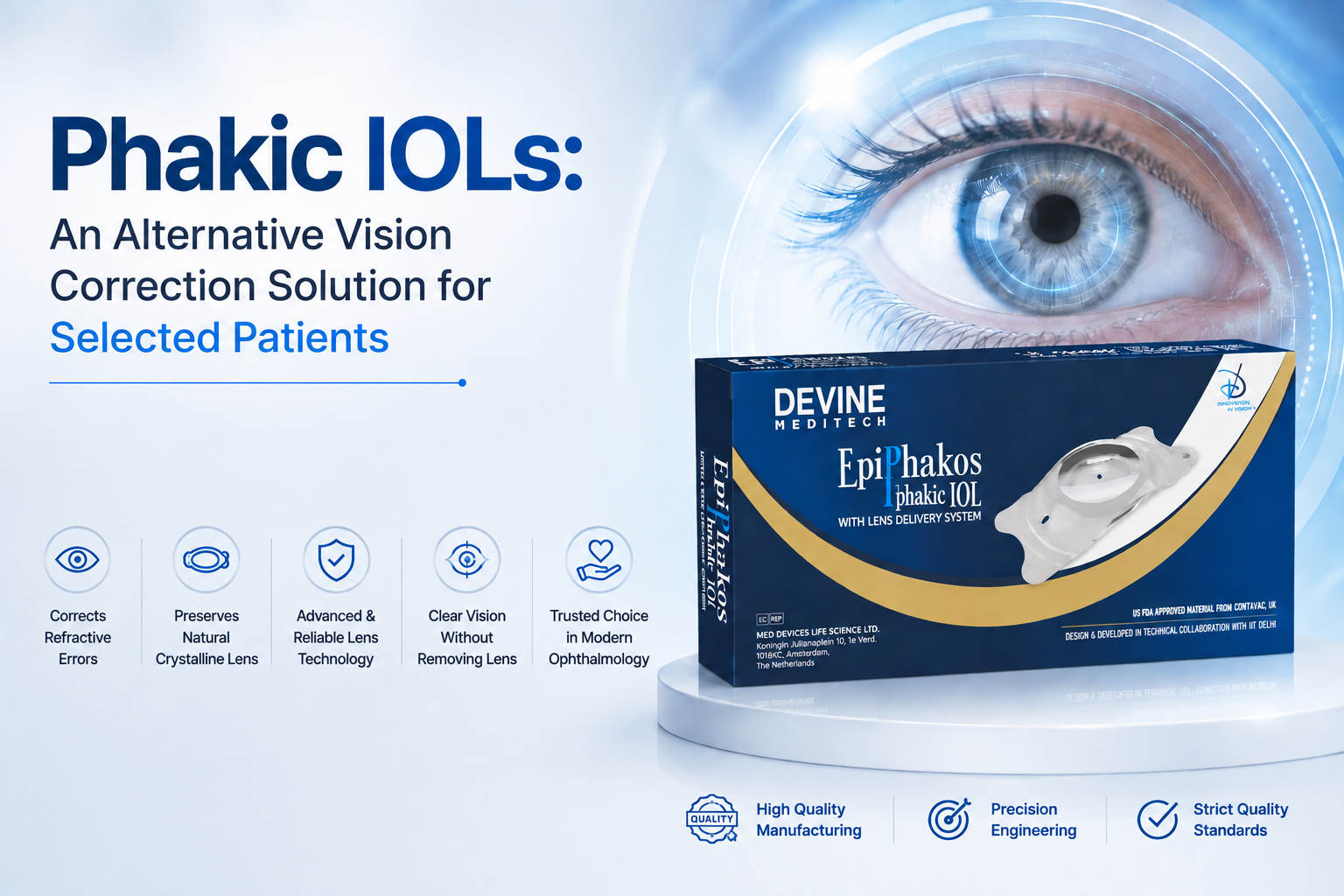
Phakic IOLs work by changing how incoming light is focused onto the retina. A carefully selected lens is positioned within the eye so that light rays are redirected toward the retina, helping provide clearer vision.
Unlike cataract surgery, the natural crystalline lens is not removed. This means the procedure is fundamentally different from refractive lens exchange or cataract surgery.
Before implantation, ophthalmic specialists perform detailed measurements and examinations to determine whether the patient is an appropriate candidate and which lens specifications may be suitable.
Phakic IOLs may be considered for selected patients who have significant refractive errors and require an alternative to spectacles or contact lenses.
They can be particularly relevant when the degree of refractive error, corneal characteristics, or other factors make laser-based correction less suitable. However, suitability cannot be determined solely by the refractive prescription.
A comprehensive ophthalmic examination is essential. Eye specialists evaluate factors such as corneal health, anterior chamber depth, endothelial cell status, pupil size, and other anatomical considerations before recommending the procedure.
One of the major advantages of Phakic IOL technology is that it provides vision correction while retaining the patient's natural lens.
Other potential benefits include:
• Correction of significant refractive errors: Phakic IOLs can be considered for selected patients with higher levels of refractive error.
• Preservation of the natural crystalline lens: The natural lens remains inside the eye.
• Optical correction inside the eye: The lens provides refractive correction without relying on external eyewear.
• Alternative to corneal refractive procedures: They may offer another option for patients who are not ideal candidates for certain laser procedures.
• Advanced lens designs: Modern Phakic IOL technologies are designed with different configurations to address specific clinical requirements.
The actual benefits and suitability vary from patient to patient and should always be assessed by a qualified eye-care professional.
The quality and precision of ophthalmic implants are extremely important because these products are designed for use inside the eye. Consistent manufacturing, material quality, optical performance, dimensional accuracy, packaging, and quality-control processes all play an important role in developing reliable ophthalmic products.
For hospitals, ophthalmic surgeons, distributors, and healthcare organizations, choosing a dependable Phakic IOL manufacturer and ophthalmic product supplier is therefore an important consideration.
Manufacturers such as Devine Meditech focus on ophthalmic products designed to support modern eye-care requirements and the evolving needs of ophthalmic professionals.
As refractive surgery continues to develop, ophthalmologists have access to a broader range of vision correction solutions. Phakic IOLs represent an important option within this expanding landscape.
Their ability to correct refractive errors while maintaining the natural crystalline lens makes them clinically distinct from several other refractive procedures. However, successful outcomes depend on appropriate patient selection, accurate preoperative assessment, suitable lens selection, surgical expertise, and proper postoperative care.
Phakic IOLs offer an alternative vision correction solution for selected patients, particularly when conventional options may not be ideal. By preserving the natural crystalline lens and providing an internal optical correction, Phakic IOL technology has become an important part of modern refractive ophthalmology. As ophthalmic technology continues to advance, high-quality lens manufacturing and precise clinical evaluation will remain essential. For eye-care professionals and healthcare providers looking for reliable ophthalmic solutions, understanding Phakic IOL technology can help support informed clinical decision-making.
Looking for reliable Phakic IOL solutions for your ophthalmic practice or healthcare organization? Devine Meditech offers a range of ophthalmic products developed to meet the evolving requirements of eye-care professionals. Connect with Devine Meditech to learn more about our Phakic IOLs and explore suitable ophthalmic solutions for your requirements.