
High myopia can make everyday activities such as driving, reading signs and recognizing distant objects difficult without strong prescription glasses or contact lenses. While refractive procedures such as LASIK and other corneal laser surgeries can correct many forms of myopia, they may not be suitable for every patient, particularly those with very high refractive errors or certain corneal characteristics. In such cases, a Phakic Intraocular Lens (Phakic IOL) can be an important refractive correction option.
A Phakic IOL is an artificial lens implanted inside the eye while the patient's natural crystalline lens remains in place. Unlike refractive lens exchange, the natural lens is not removed. Phakic IOLs are generally considered for patients with moderate to severe refractive errors and require careful preoperative assessment by an ophthalmologist.
A Phakic IOL is designed to provide additional focusing power inside the eye without removing the natural crystalline lens. Depending on the design, a Phakic IOL can be positioned in the anterior chamber or posterior chamber.
Devine Meditech's Phakic IOL is designed for implantation in the posterior chamber behind the iris, making the lens less visible to the naked eye. The company's product page describes a 2.2 mm incision, hydrophilic acrylic material, optimized vaulting and multiple holes intended to support pressure equalization between the front and back of the lens.
The Devine Phakic Aspheric IOL range includes models with different overall lengths and a stated diopter range from +6.0D to -18.0D in 0.5D increments, providing options for a broad range of refractive requirements.
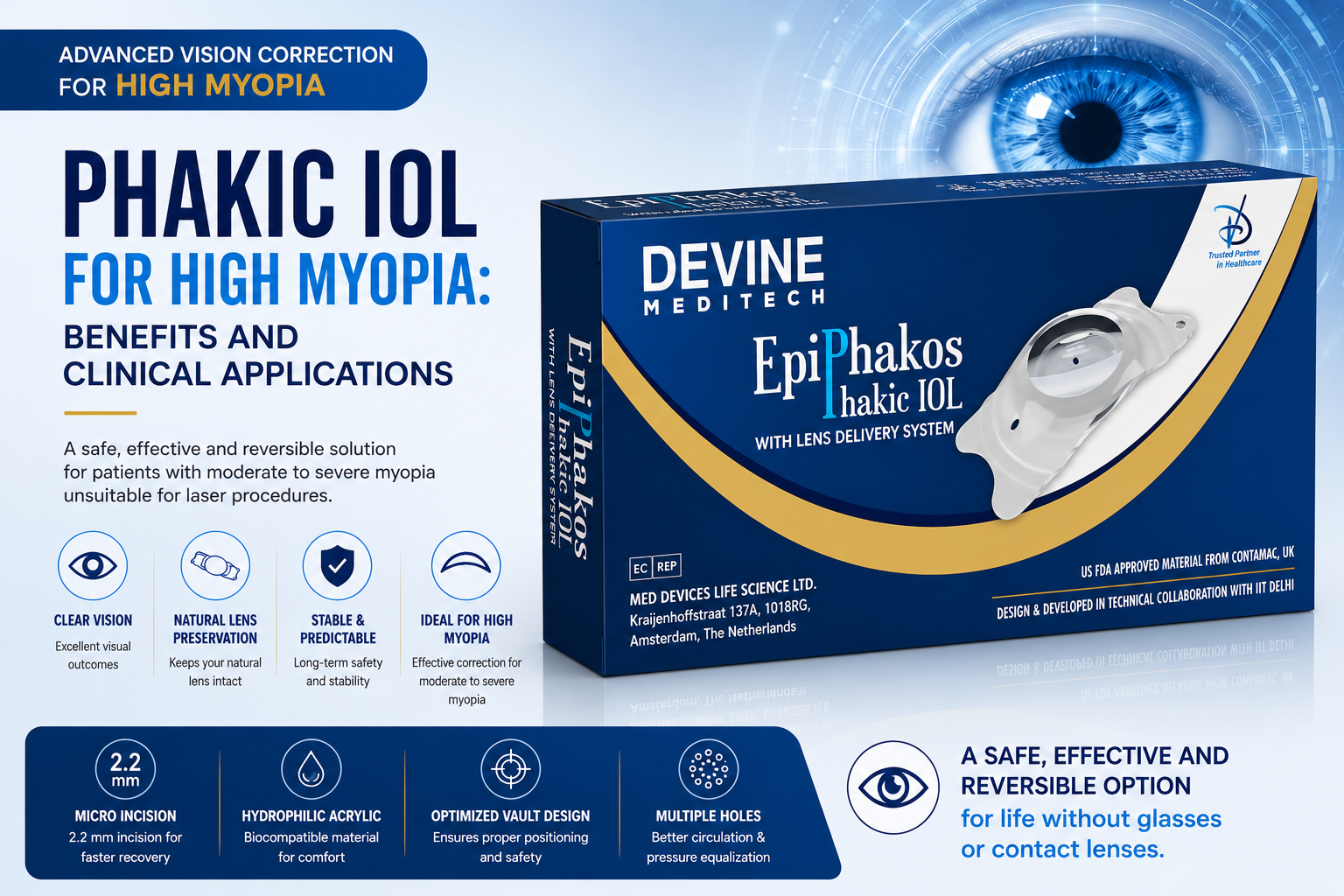
One of the major applications of Phakic IOLs is the correction of higher degrees of myopia. For some highly myopic patients, corneal laser surgery may not be the preferred option because the amount of corneal tissue that would need to be altered can be a consideration.
Clinical literature indicates that Phakic IOLs can provide predictable refractive correction in moderate to high myopia. Comparative evidence has also reported advantages in areas such as contrast sensitivity and preservation of best-corrected visual acuity compared with some excimer laser approaches.
Another important benefit is that the natural crystalline lens remains in place. This allows the eye to retain its natural lens until a later stage of life, subject to the patient's clinical circumstances and ophthalmologist's recommendations.
1. Correction of Higher Myopia
Phakic IOLs can be considered when patients have significant myopia that may be difficult to manage with corneal refractive procedures. Certain Phakic IOL designs are specifically indicated for substantial myopic prescriptions.
2. Natural Lens Preservation
Unlike refractive lens exchange, Phakic IOL implantation does not require removal of the natural crystalline lens. This is particularly relevant when considering refractive correction in younger patients who have not yet developed presbyopia.
3. Stable Refractive Correction
Studies have reported good refractive predictability and stability following appropriately selected Phakic IOL implantation.
4. Option for Patients Unsuitable for LASIK
Patients with certain corneal characteristics or very high refractive errors may not be ideal candidates for laser-based corneal procedures. Phakic IOLs provide an alternative refractive approach that does not require reshaping the cornea.
5. Posterior Chamber Placement
For posterior chamber designs, the lens is positioned behind the iris and in front of the natural crystalline lens. Devine Meditech's Phakic IOL is designed around this placement, with optimized vaulting intended to maintain appropriate positioning within the eye.
Phakic IOLs are primarily used for refractive correction in patients with moderate to severe myopia. They may also be considered in selected cases involving myopic astigmatism when an appropriate lens design is available.
Patient selection is an essential part of the process. Factors such as age, stability of refraction, anterior chamber anatomy, endothelial cell count, intraocular pressure and overall ocular health may need to be evaluated before surgery. Conditions such as glaucoma, active inflammation, cataract, retinal disease or other ocular abnormalities can affect suitability.
For this reason, Phakic IOL implantation should always be performed following a comprehensive ophthalmic examination and individualized surgical assessment.
LASIK, PRK, SMILE and Phakic IOL implantation each have different indications and considerations. Corneal laser procedures reshape the cornea to modify its refractive power, whereas a Phakic IOL adds refractive power inside the eye.
For patients with high myopia, studies have found Phakic IOLs to offer favorable refractive predictability and visual outcomes in appropriately selected eyes. One comparison of Phakic IOL and SMILE in high myopia reported better refractive accuracy, uncorrected distance visual acuity and subjective visual quality with ICL implantation.
The choice, however, should never be based on refractive power alone. An ophthalmologist must evaluate the patient's complete ocular anatomy and visual requirements.
For hospitals, ophthalmic surgeons and distributors, the quality and design of the IOL are important considerations. Material properties, optical design, available power range, sizing, vault characteristics, manufacturing quality and sterilization processes can all be relevant when evaluating a Phakic IOL.
Devine Meditech offers a Phakic Aspheric IOL manufactured using hydrophilic acrylic material, with multiple model sizes and a stated power range extending to -18.0D. The product is positioned for correction of moderate to severe myopia and is designed for posterior chamber implantation.
Phakic IOLs have become an important option in refractive surgery, particularly for selected patients with moderate to high myopia who may not be suitable candidates for corneal laser procedures. By providing refractive correction while preserving the natural crystalline lens, Phakic IOLs offer a distinct approach to managing significant myopic prescriptions.
For ophthalmic professionals and healthcare institutions evaluating Phakic IOL solutions, factors such as lens design, material, power range, sizing, manufacturing quality and patient suitability should be carefully considered. Devine Meditech's Phakic IOL range offers posterior chamber placement, hydrophilic acrylic construction, optimized vaulting and multiple sizing options for clinical applications requiring high myopic correction.
Note: Phakic IOL implantation is a medical procedure. Patient suitability, lens selection and surgical decisions should be determined by a qualified ophthalmologist following a complete eye examination.